
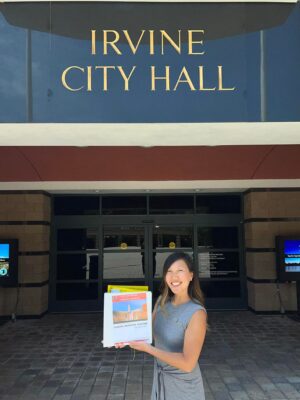
RCV advocate Branda Lin (above)
Ranked-choice voting can produce a majority winner. It cannot manufacture a majority of the electorate. That’s arithmetic, not a partisan talking point.
Ranked-choice voting (RCV) is being considered for future Irvine mayoral and City Council elections. Its advocates tout the prospect of a winner with majority support. Sounds impressive, doesn’t it?
But! A majority of votes counted in the final round is not the same as a majority of Irvine’s registered voters. Apparently, even election reform has a marketing department.
Let’s look at Irvine’s 2022 mayoral election offers a useful reality check. I’m convinced this is where Mayoral candidate Branda Lin became convinced in Ranked Choice Voting were in place, she would have beaten incumbent Mayor Farrah Khan. Lin had an excellent second place showing dspie launched a campaign late; see below.
The numbers don’t lie. Campaign slogans might.
In the November 8, 2022 election, Irvine had 153,389 registered voters. Only 84,663 ballots were cast. Turnout was 55.2%.
Here’s how the mayoral race played out:
| Candidate | Votes | Share of candidate votes |
|---|---|---|
| Farrah N. Khan | 29,628 | 37.8% |
| Branda Lin | 21,560 | 27.5% |
| Simon Moon | 14,834 | 18.9% |
| Katherine Daigle | 7,184 | 9.2% |
| Tom Chomyn | 5,129 | 6.6% |
| Total votes for candidates | 78,335 | 100% |
| Blank or invalid mayoral votes | 6,328 | — |
| Total ballots cast citywide | 84,663 | — |
| Registered voters | 153,389 | — |
Source: Irvine’s 2022 election results.
Farrah Khan won the mayor’s race. But she received just 29,628 votes, or 19.3% of Irvine’s registered voters.
Read that again. Fewer than one in five registered voters cast a vote for the winning candidate. And a full 7.5% left the race blank.
More than 123,000 registered voters did not vote for Khan. That doesn’t invalidate her victory. It does put the word “mandate” in serious need of adult supervision.
Enter ranked-choice voting, stage left
Irvine is considering RCV for future mayoral and City Council elections, potentially beginning in 2028, subject to the applicable ballot measure and implementation requirements.
Under RCV, voters rank candidates in order of preference. If no candidate wins a majority of first-choice votes, the lowest-ranked candidate is eliminated. Votes are redistributed according to the next available preference. The process continues until a candidate reaches the required majority of continuing votes.
That can identify the candidate preferred by a majority of voters whose ballots remain active in the final round.
But notice what RCV cannot do.
It cannot drag nonvoters to the polls. It cannot turn an indifferent electorate into an enthusiastic one. And it cannot convert a minority of registered voters into a majority simply by eliminating candidates until the numbers look more impressive. And if RCV demands a 50%+ majority, those voters who don’t vote means no one is democratically elected (45% of Irvine’s voters didn’t bother that year).
Imagine Irvine has 153,389 registered voters, but only 75,000 ballots are cast. A candidate wins 40,000 votes in the final round after other candidates are eliminated. Congratulations! That’s a majority of the final-round votes. But it’s only 26.1% of the registered electorate.
If ballots become exhausted because voters did not rank any remaining candidates, the final-round total can shrink even further. A candidate might win a majority of the votes still being counted while receiving support from a much smaller share of the original electorate.
The campaign literature can trumpet a “majority winner.” The math still says otherwise.
Let’s be precise about the distinctions:
- Majority of final-round votes: More than half of the votes that remain active in that round.
- Majority of ballots cast: More than half of all ballots initially submitted. This is a different threshold.
- Majority of registered voters: More than half of everyone registered in Irvine. That’s a far higher bar.
These are three different measures. Anyone who treats them as interchangeable is selling a slogan, not explaining election results.
RCV cannot solve the problem of low participation. If only half the electorate votes, the winning candidate still emerges from that half. If fewer people participate, the gap grows. No amount of ballot redistribution changes who stayed home. That’s why Irvine residents should be skeptical whenever advocates suggest that RCV automatically gives a mayor a broad democratic mandate. A candidate can be the most acceptable choice among participating voters without being the choice of most Irvine residents. Those are not the same thing.
If Irvine adopts RCV, election officials should publish more than the final winner and a celebratory percentage.
Residents deserve to see:
- The number of registered voters.
- The total number of ballots cast.
- Each candidate’s first-choice votes.
- The number of ballots exhausted during tabulation.
- The final-round vote totals.
- The winner’s support as a percentage of both active final-round ballots and the registered electorate.
That would let residents judge the results for themselves. What a refreshing concept.
Irvine’s 2022 mayoral election illustrates the problem. Farrah Khan won with 29,628 votes in a city with 153,389 registered voters. That’s 19.3% of the registered electorate. RCV could change how a future winner is selected. It cannot change the basic arithmetic of voter participation. A majority of the final-round votes is not a majority of Irvine. A winner is not automatically a mandate. And rearranging the ballots doesn’t rearrange reality.
If RCV advocates want to claim that their system produces majority support, they should be very clear about whose majority they’re talking about. Because when fewer than one in five registered voters support the winner, calling it a mandate requires a generous definition of the word—and a very forgiving calculator.