
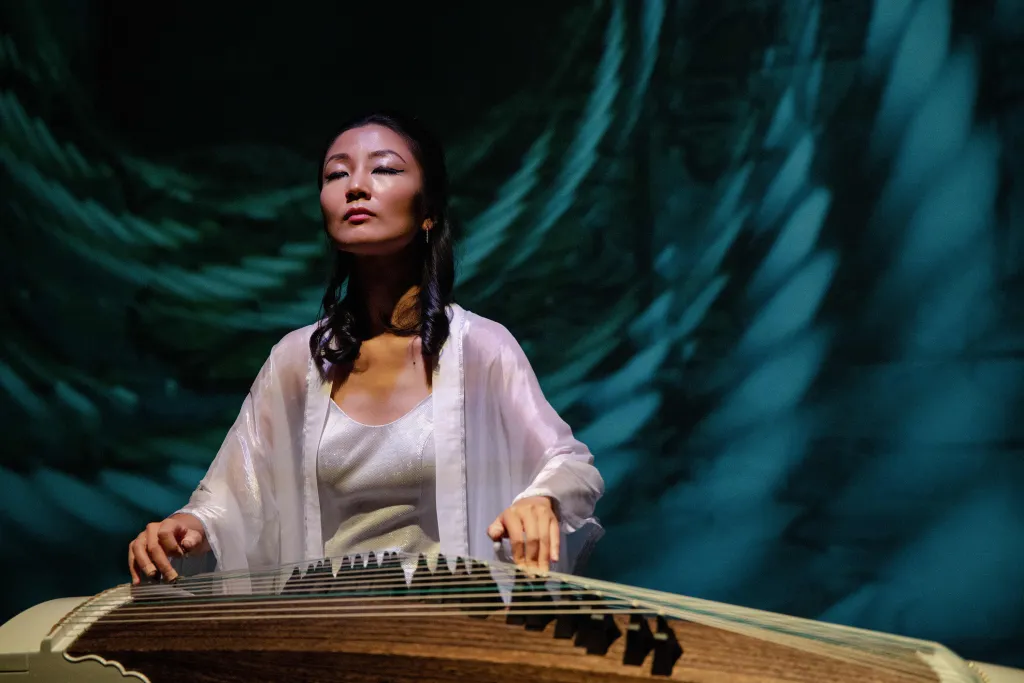
It might be surprising at first to hear contemporary music featuring a guzheng or guqin, which are traditional Chinese stringed instruments in the zither family. But as you listen to the soothing sounds meld with an electronic backdrop, it all seems to make sense.
Globally acclaimed musician Bei Bei Monter of Irvine takes this modern approach, blending East and West styles, when creating compositions with the ancient instrument whose origins can be traced back over 2,500 years. The guzheng’s resonant sound has been described as shimmery or dreamy with a harplike quality that mimics flowing water or falling rain. Monter, who goes by the artist name Bei Bei, embraced a contemporary sound after being introduced to jazz in college, exploring a broader music palette and learning to express herself in a new way.
“It’s building a connection outside of language,” she said. “Because there are a lot of things we can’t really communicate in language that clearly. But music can speak for itself. The emotions and the way you are focused … the way you present yourself on stage … you’re offering yourself.”
Monter has performed as a soloist with the Pacific Symphony and for recordings of film, TV and video game soundtracks such as the second season of “Avatar: The Last Airbender,” which premiered in June on Netflix; “Battlestar Galactica” on Sci-Fi Channel (now called Syfy); DreamWorks’ “Kung Fu Panda 4” and Disney’s “Turning Red” and live-action “Mulan,” including the song “Loyal Brave True” with vocals by Christina Aguilera. Her distinctive playing has also been featured in commercials for major brands including GEICO, Taco Bell and Peacock, as well as within Universal Studios Beijing, which opened in 2021.
When it comes to her original music, Monter has found much success, too. Her music videos on YouTube have millions of views, striking a chord with audiences, while her latest album, “Two Moons,” created in collaboration with London-based composer and producer Paul Elliott, has received much acclaim.
Across seven original tracks, Monter moves fluidly from jazz-influenced improvisation to ambient soundscape and contemporary instrumental pieces interwoven with Elliott’s rhythmic experimentation, analog-inspired electronics and atmospheric production on “Two Moons,” which has been entered for Grammy Award consideration in the Contemporary Instrumental Album category, along with one of the album’s songs, “Gaoshan Electronica,” for Best Global Music Performance.
The pair already racked up two silver medals at the Global Music Awards in 2025 in the Album and World Fusion categories. They also snagged top honors for the New Age/Ambient category at the Hollywood Independent Music Awards in July and received the highest recognition for Asian Jazz and Crossover album and Contemporary Instrumental piece for the compilation’s final track, “Midnight Bizarre,” at the InterContinental Music Awards in August.
The album’s title track, also called “Two Moons,” was inspired by the Chinese Mid-Autumn Harvest Moon Festival. This emotional song blends the guzheng’s timeless beauty with organic lo-fi electronic textures. The opposite of a catchy pop song that stays in your head, Monter said, the tune has many layers that reveal themselves the more you listen to it.
“It just comes out – that feeling of missing families, home, people I don’t see, you know, my childhood, all that connection. It just comes through so naturally in the music,” Monter said. “Maybe the things I experienced growing up, all that kind of just flows in that (song), and a lot of people tell me … the more you listen to it, you really kind of get deeper into it.”
In the Beginning
Growing up in Chengdu, in the Sichuan province of southwestern China, her name was Bei Bei He, which means lotus bud in Chinese. She wanted to take guzheng lessons the moment she heard the instrument while visiting the home of a friend who played it. Monter (her married name) was only 6 years old at the time, but she was mesmerized.
“I just fell in love with it like instantaneously. It’s almost like magic,” said Monter, who kept nagging her mother for weeks until she finally realized her daughter was serious.
Luckily, one of her mom’s co-workers at a local school had a daughter who played the guzheng and was able to recommend an instructor at a conservatory in the area. While Monter doesn’t recall exactly what drew her to the instrument at first – maybe its sound or impressive size – there are many reasons she has kept with it through the years.
“It’s such an elegant instrument,” Monter said. “You can really bring a lot of grace through the music. But also, it’s very dynamic. It gives you power, too. It gives you a lot of expression. And the technique is actually quite complicated. There are many different techniques you can use to play the instrument. So that part is fun and challenging …. (And) I can really bring myself to a higher awareness while playing the instrument. I can feel fully connected to my creative power.”
She plays both the guzheng, which has 21 strings on a 5-foot-long wooden soundboard, and the shorter, seven-string guqin, which she added to her repertoire during college in Hong Kong. While there are some similarities to a harp or dulcimer, the guzheng and guqin are laid flat across a stand or table and played while sitting.

They are both fretless instruments, but the guzheng’s strings rest on a row of movable bridges whose placement determines the basic pitch of each string. A player uses finger picks to pluck strings to the right of the bridges while using his/her left hand to press down or “bend” strings on the left side of the bridges to alter string tension and pitch. This can add vibrato or expressive slides and create accidental notes that fall in between the tuned string sounds. For comparison, the guqin has no bridges.
“With the right hand, you can pluck the strings with the picks (for) single notes,” Monter explained. “You can do chords, arpeggios and you can do tremolo – basically a fast repetition of one note on one string and make long-lasting notes. And also you can do percussive sounds: You can hit different parts of the instrument to make it more like a drum. It’s very fun.”
Monter said the guzheng and guqin are both difficult in their own way. Since the guqin has one-third the number of strings, the player must use the left-hand string bending technique more often to create more notes.
“They actually are very different, even though they both start with the word ‘gu.’ But, actually, ‘gu’ in Chinese means ‘ancient,’ ” Monter explained. “In ancient times, people … just called them zheng and qin. We modern people will add ‘gu’ in front of those two names to emphasize (that they are) from ancient times.”
The guqin is much older than the guzheng, she noted. “And it has a very meditative tone to it,” she said. “It’s very good for your soul. I mean, I often practice at nighttime before I go to bed. It helps me to calm down. The sound is so soothing. You will not disturb people, you know. And you also help yourself to kind of just wind down, become more centered, be quiet. So I really like that.”
Monter trained at China Central Universities of Nationalities (now called Minzu University of China) in Beijing and the Hong Kong Academy for Performing Arts under several guzheng masters. After coming to California, she continued her education in music recording at Azusa Pacific University and Citrus College, and studied jazz performance at Fullerton College.
Finding Her Sound
After learning to play traditionally, Monter began to gravitate toward a more modern sound, even incorporating different genres like jazz, funk, hip-hop and electronica.
“I think the seed or the will of wanting to do that started when I was in Hong Kong … around 2002. I just started listening to jazz music,” she recalled.
Someone suggested that she check out music by Miles Davis, so she listened to his “Kind of Blue” album and was hooked. That opened the door, leading her to explore other jazz greats and broaden her musical taste, even sampling electronic music from Europe, like Enigma, who became one of her favorite artists.
“Before that, I think mostly I listened to either Chinese music or classical music or pop songs,” she said.
“I felt at that moment, there was a different way to express music. Rather than just playing what I already know,” she said. “It made me want to try something different. But I didn’t know how. Even though I had the will to do it, I didn’t know how I could do it.”
So, after coming to the United States, she began studying jazz performance and now it permeates many of her compositions. For example, the song “Silk Soiree” on the “Two Moons” album is influenced by jazz. It can be heard in the chord progression and the way she improvised the over-five-minute piece – her preferred way to compose.

Two Moons
Monter began this project, her fifth full-length album, after taking a few years off when her daughter, Leah, was born. In late 2023 or early 2024, Monter decided it was time to start making music again. She reached out to Elliott, a longtime friend in London and they decided to work together.
“I told him, ‘Hey, I want to make a really avant-garde, edgy electronic music album. Can you produce electronic music for me? You know, record and write with me?’ ” she recalled.
He agreed and it took two years of work, but the album finally came out this past February, during Lunar New Year.
Reflecting on the title track, Monter said it was created in 2024 on the day of the Mid-Autumn Harvest Moon Festival, which is usually in September or early October, although the exact date changes based on the lunar calendar.
Elliott had created a soundbed of electronic music for Monter so she went upstairs to the recording studio in her home and began playing the guzheng as she listened to the electronic beats in the background.
“I just decided to sit in front of my instrument, put my headphones on and press the record button,” she said. “I just improvised because that’s how I normally write. I start from improvisation and then I try to work on maybe refining the idea, adding things to it later on in post-production, or I practice it again and re-record.”
This song is almost entirely improvised, she said, with a few parts added later to provide more layer or texture. Monter is proud of how the piece turned out, calling it her masterpiece, filled with tenderness and vulnerability.
“I feel it’s really beautiful,” Monter said. “I think the feeling came out very naturally that night. Maybe it was influenced by the moon …. I feel I really absorbed the energy that night of the Mid-Autumn Harvest Moon … and I just let it come out naturally in the music …. I feel like I was really in touch with who I am truly as a person.”
After finishing her recording session, she came downstairs and started washing dishes in the kitchen. She glanced up at the night sky through the window and saw two moons. Of course, one was just a reflection in the glass, but the effect was impressive.
Monter grabbed her digital camera to take a photo, which became part of the album cover. And “Two Moons” became the name of the song and album, the image representing the dualities that coexist in her music: East and West, ancient and modern, acoustic and electronic and even the physical and spiritual selves. She pulls from history, tradition and cultural heritage, but creates something new and innovative.
-

Bei Bei Monter (front row, second from left) performs with students and Pacific Symphony in 2025. Photo courtesy of Bei Bei -

Bei Bei Monter (front) performs with Pacific Symphony during a Lunar New Year Concert in 2022. Photo courtesy of Bei Bei -

Bei Bei Monter (third from right) plays guzheng with her Bei Bei Traditional Chinese Ensemble. Photo courtesy of Bei Bei -

Bei Bei Monter (second from left) performs with her Bei Bei Fusion Band at Casa Romantica in San Clemente earlier this year. Photo courtesy of Bei Bei -

Award-winning musical artist Bei Bei Monter plays and composes music on the guzheng, an ancient Chinese stringed instrument. Photo courtesy of Stephanie Parkinson
Sharing Her Music
Monter’s music has led to her collaborating with international artists including Shawn Lee, Fingazz and Elliott. And it’s taken her across the U.S. and abroad to perform in India, Hong Kong, Shanghai, Italy, Canada and the United Kingdom.
“It’s just such a beautiful art,” she said. “There should be more people hearing about it because every time I play, I reach somebody. They all love it.”
In recent years, she has mostly performed locally to stay close to her family. Aside from music, Monter enjoys cooking, hiking and spending time with her daughter and husband, Jon, who plays guitar. Sometimes they play together as a fusion duo, performing pop music covers and some of Monter’s original music. She also has a four-piece Bei Bei Fusion Band with her on the guzheng as well as a drummer, electric bass player and her husband on electric guitar.
“That’s how we’ve been able to reach more people is through this kind of music because if you just play traditional music, it can sometimes be hard,” she said. “When you play contemporary stuff, people say, ‘This is so cool.’ ”
EVENT DETAILS
Bei Bei at the Irvine Global Village Festival
When: Festival is Oct. 10 from 10 a.m. to 6 p.m.; Bei Bei and her students perform from 4:10 to 4:40 p.m.
Where: Great Park, Irvine; Bei Bei’s group, East West Cultural Association of America (EWCAA), plays on the Concordia University Irvine Stage/Ballon Lawn
She also has a new group, Bei Bei Traditional Chinese Ensemble, which performed a five-concert series at different branches of the Orange County Public Libraries. And she occasionally plays with her music students including a performance planned Oct. 10 at the Irvine Global Village Festival, which runs from 10 a.m. to 6 p.m. in Great Park.
Billed as Orange County’s premier multicultural event, this year marks the family-friendly festival’s 25th anniversary of bringing the community together to celebrate the traditions, art, music and food of cultures from around the world. Attendees can expect a wide range of music and dance performances, food vendors offering global cuisine and festival staples, handmade goods and art for sale, crafts and interactive activities in the Kids Village, art exhibits and cultural displays showcasing history, traditional dress, culinary and religious traditions.
Monter’s students will perform as East West Cultural Association of America (EWCAA) on the Concordia University Irvine Stage/Ballon Lawn from 4:10 to 4:40 p.m. While she teaches all ages, this show will include about 10 of her teenage and adult students with subsets performing different pieces including some solos for a total of about six songs.
Monter plans to play two or three pieces with her students including “Gaoshan Electronica,” from her “Two Moons” album. Notably, “gaoshan” means high mountains in Chinese and this piece was inspired by folk music of the Qiang ethnic minority group that lives in high-altitude regions of southwestern China, which is part of Monter’s background. “So this piece was a tribute to my own heritage,” she said.
In addition to performing and composing music, Monter feels called to give back to the community by teaching and thereby sharing her skill with students who want to learn to play the guzheng and stay connected to their Chinese cultural roots.
“A lot of them might grow up here or maybe relocated here when they were young, but they still … want to be part of their heritage and their culture,” she said.
Giving lessons also provides another income source as any creative career path can prove difficult to make a living.
“Being a musician is so hard,” Monter said. “This path is very, very, very difficult. But also the reward is very big.”
This article originally appeared on Bei Bei Bridges the Divide Between Traditional and Modern Music. Visit Culture OC for more arts and culture coverage from Orange County, CA.