
And the beat goes on.
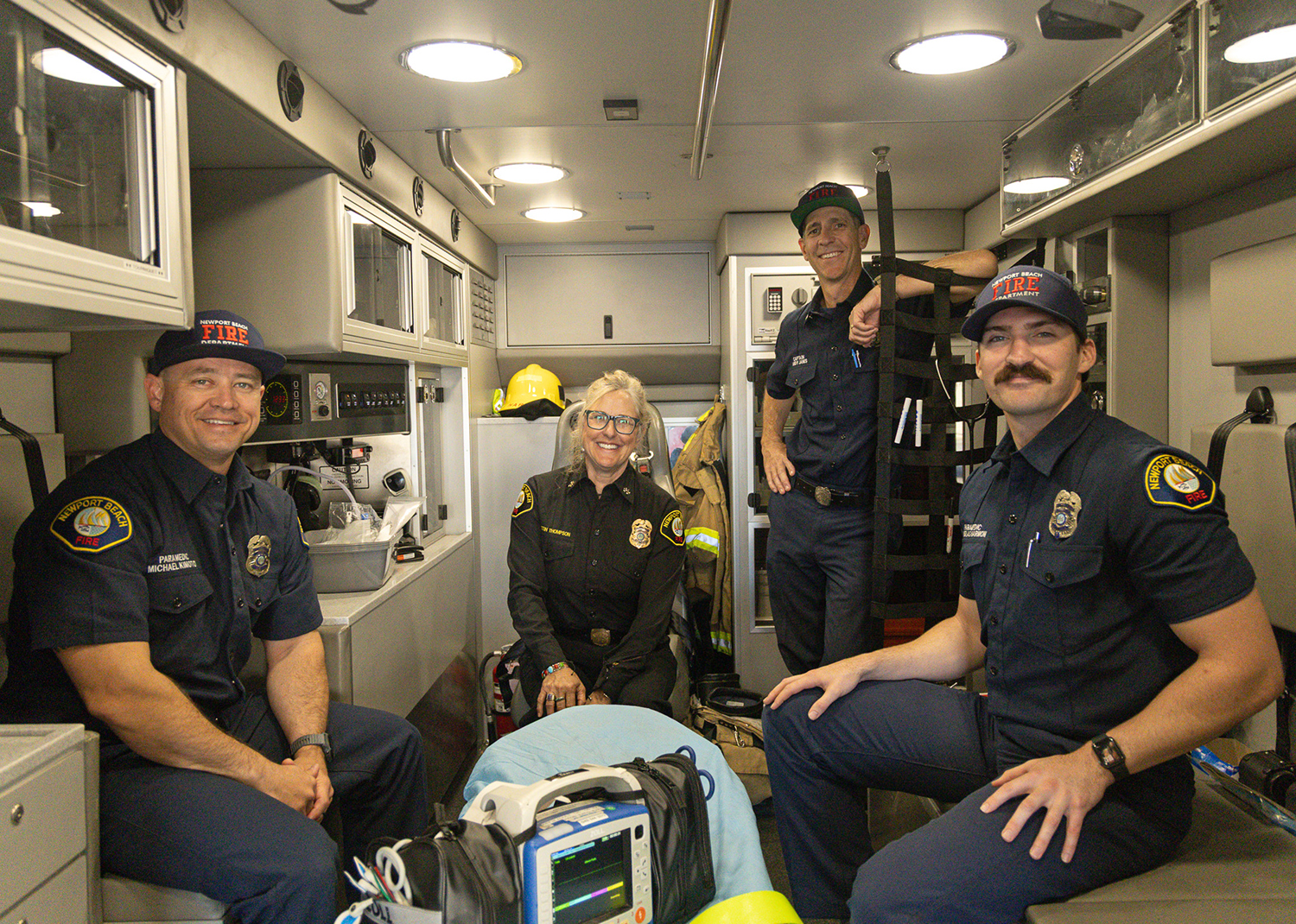
But when it doesn’t, that’s when Newport Beach Fire Department’s paramedics spring into action. They arrive at the scene of such critical health emergencies as heart attacks, strokes and devastating traffic accidents on average under five and one-half minutes after frantic 9-1-1 calls for help.
A paramedic is a specialist among specialists in the NBFD, requiring up to 1,800 hours of intense schooling and training beyond normal firefighter requirements, said Emergency Medical Services Division Chief Kristin Thompson, who oversees a $3.8 million annual budget dedicated to health emergency services.
Every fire fighter is a trained Emergency Medical Technician, able to competently attend to less serious physical injuries, Thompson explained. California mandates that EMTs and paramedics undergo retraining every two years; EMTs receive 24-hours of training, while paramedics attend 448 hours in that time frame.
Newport Beach lifeguards from captain to chief rank are all certified EMTs, while rank-and-file lifeguards are Emergency Medical Responder Certified, and must complete 54-hours of emergency medical training annually. Times are mandated by the state, and total nearly 6,000 hours annually by Newport’s fire and lifeguarding services.
In national, statewide and county comparisons of cardiac emergency survival rates, Newport’s numbers are “two to two-and-one-half times” that of the aforementioned regions, Thomson shared, a remarkable number in that Newport’s population is on average older than those in most areas.
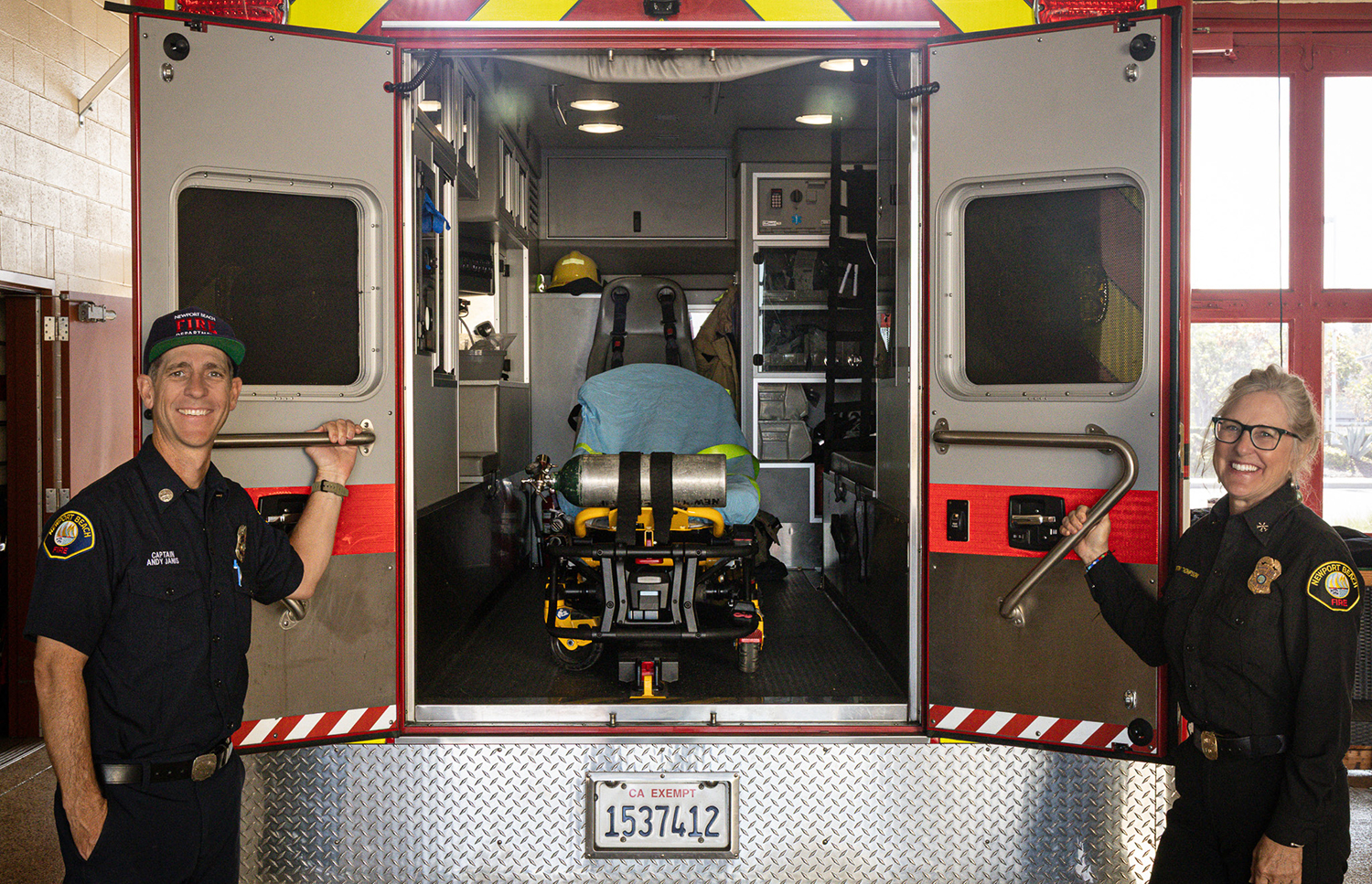
Newport Beach residents can be assured that on every medical call, there will be at least two EMTs, and that on every piece of equipment, there will be at least one paramedic. “This way we don’t ever have to request a paramedic from any other agency,” Thompson emphasized.
Newport operates four fire ambulances staffed with two firefighter/paramedics. In the field, paramedics can do almost everything doctors in a hospital initially do based on critical thinking, and their assessment skills, Thompson said.
Paramedics must look at the signs and symptoms, then provide what is technically referred to as a “differential diagnosis” if there’s an allergic reaction to some food or prescription, or an actual cardiac event or stroke (officially, only licensed physicians can diagnose).
“Although treatments and protocols are written in a manual published by the County, paramedics must commit all of that to memory without having a physician telling them what to do,” Thompson explained.
That might include choosing the right pharmaceutical out of more than 20 stocked on every ambulance, including narcotics for pain management; when and where to insert an IV; when to intubate should an airway be blocked; when and/or where to drill into bone to insert an IV; how and when to remove someone from a tangled and mangled car crash without compromising a victim’s spinal integrity, and so much more. All of this may be on top of paramedics’ firefighting responsibilities.
The Newport Beach Fire Department receives about 14,000 calls a year, with around 11,000 being EMS related. Approximately 60 percent involve advanced life support. On-scene presence by the fire department teams averages between 10 and 15 minutes before transportation to a hospital, Thompson shared. But depending on the nature of the call, delivery time to hospitals outside of Newport adds precious moments that may impact a patient’s survival chances should it be a life-threatening situation. Rush hour traffic could become a life-or-death determinant.
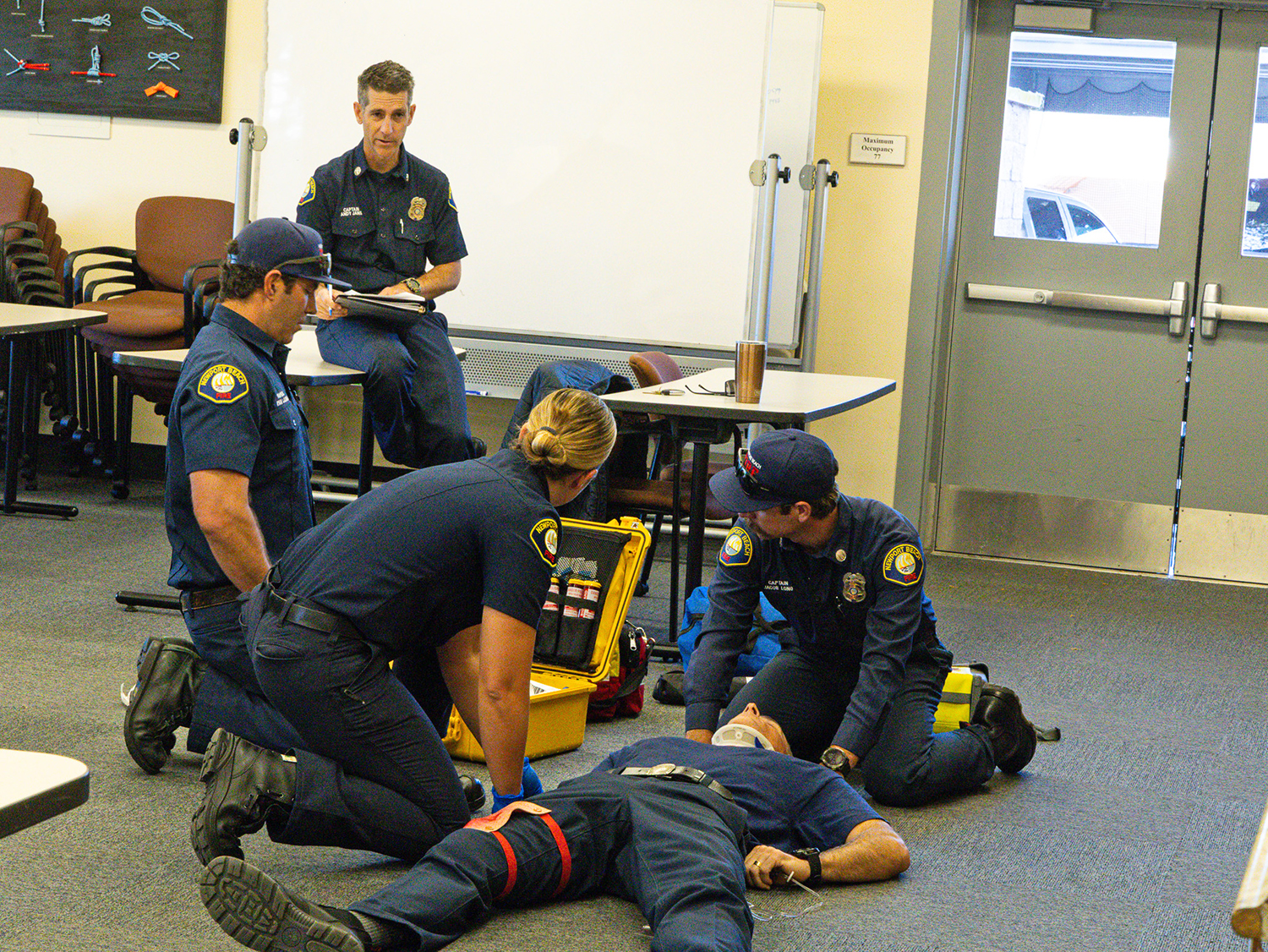
Oftentimes, when cardiac events occur, citizens step in to administer CPR (cardiopulmonary resuscitation) before a fire unit arrives. What most people don’t realize, however, is that it takes up to 120 compressions per minute to sustain oxygenation, a feat that requires an Olympian effort on the part of good Samaritans. Teamwork is almost a necessity while awaiting fire personnel. Fortunately, Newport employs the latest in CPR equipment to quickly take over from most likely fatigued bystander-heroes. In 62 percent of the emergency calls, citizens were involved directly. In many instances, according to Division Chief Thompson, police and fire dispatchers talk nervous and/or untrained citizens through the stressful CPR process.
Life-saving applications seem easy when seen on TV or in movies, but when it comes to reality, untrained individuals may choke up. To minimize that occurrence, the fire department offers CPR instruction through their volunteer CERT (Community Emergency Response Team) program; seminars at homeowners’ associations; at schools, and more.
Throughout government buildings, at all schools, most public institutions and in countless businesses, citizen lifesavers may find AEDs — Automatic External Defibrillators — conveniently placed for immediate use. No instructions necessary, for when the paddles are applied to the chest, a recorded voice from the compact, battery-powered device talks the user through the process. If the AED senses that no heart attack is occurring, the machine remains passive, but ready.
With Newport’s always-ready, high performing, life-saving services, residents can feel secure in that survival chances in health-emergency situations are two and one-half times greater here than elsewhere in the country—yet another reason why Newport Beach is one of America’s premier communities in which to live.
For more information, go to newportbeachca.gov/fire, or call (949) 644-3381.
The post When Every Second Counts, Newport Beach Paramedics Deliver appeared first on Newport Beach News.