

After 41 years with Yamaha Corp., Seiichi Yamaguchi is bringing a new organizational structure to the musical instrument maker’s U.S. operations.
Yamaguchi became president of Yamaha Corp. of America (YCA) in April, succeeding former president Tom Sumner, who retired in September. One of his first moves was to reorganize the business into four product-focused divisions to align the subsidiary more closely with its Japanese parent as the company adapts to an increasingly global business.
The restructuring is intended to improve efficiency and communication between the two operations, particularly around product development and distribution.
“If we look completely different and function completely different than how our parent company does, it adds an extra degree of difficulty,” Yamaguchi told the Business Journal.
The new divisions are organized around Yamaha Corp. of America’s core product segments: piano, guitar, band and orchestral, and digital music instruments. Each group has its own general manager and handles functions previously shared across the instrument business, including sales, artist relations and marketing.
“In order for us to continuously operate, we have to adapt, particularly in a changing environment,” Yamaguchi said.
Changes Reflect Shifting Global Marketplace
The changes come as Yamaha has evolved from a Japan-based manufacturer into a global company. When Yamaguchi joined the company in 1985, about 80% of its business came from Japan and 20% from international markets. Today, more than 80% comes from overseas, with the U.S. accounting for 20% to 25% of Yamaha’s international sales.
The publicly traded parent company recorded revenue of about $2.9 billion for the fiscal year ended March 31, 2026.
Founded by Torakusu Yamaha in Hamamatsu, Japan, in 1887, the company began with reed organs and upright pianos. It has since expanded into a portfolio of more than 4,000 stock keeping units, or SKUs, ranging from a $150 acoustic guitar to a $200,000 sound system.
Its instruments have been played by some of the biggest names in music, including Elton John, Alicia Keys, John Legend, Sarah McLachlan, Sheryl Crow and Paul McCartney. Locally, Grammy-winning musician Jon Batiste performed on a Yamaha grand piano at the 2025 NAMM Show in Anaheim. For Elton John’s 2011 Las Vegas residency, Yamaha designed a $1 million piano for the legendary musician.
Yamaha established its U.S. operation in Buena Park in 1960 and has built a network of approximately 2,000 dealers and retailers. The company adopted the Yamaha name in 1987, marking its 100th anniversary.
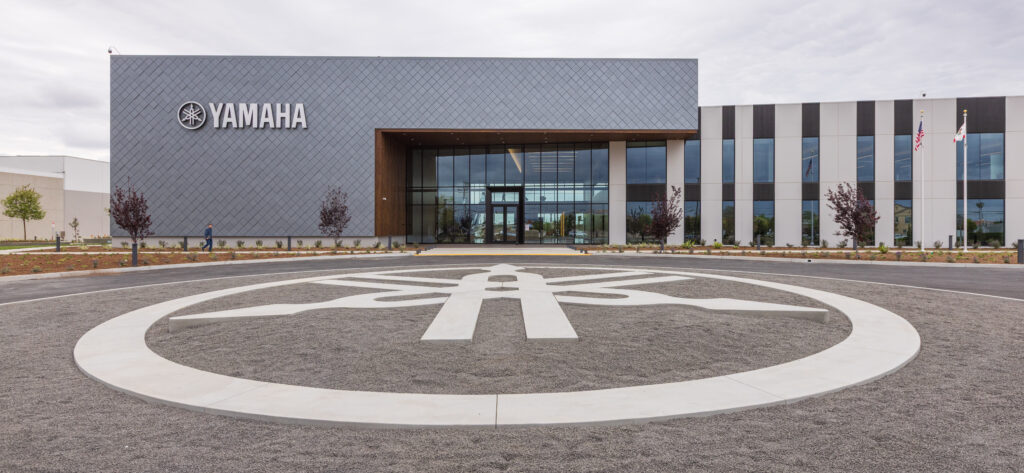
Today, its U.S. subsidiary operates from a newly built 75,263-square-foot Buena Park headquarters that houses the company’s sound and music teams of about 350 employees.
Decentralizing Power
Yamaguchi said the new structure will give each product division more direct responsibility for its business and customers. Previously, Yamaha’s instrument groups shared a sales department, an artist relations team and an integrated marketing team. Under the new structure, each division manages those functions for its respective products.
Garth Gilman, corporate vice president of the musical instruments business unit, said the new structure gives each division dedicated leadership to better serve its customers and channel partners.
“We have to always be looking toward, ‘how do we change things in order to meet the opportunities of the market, or perhaps the challenges of the market,’ and be very agile,” Gilman said.
Beyond the organizational changes, Yamaguchi is focused on product development and how Yamaha can combine traditional instruments with emerging technologies, including artificial intelligence.
He said the company’s technology strategy centers on enhancing the abilities of musicians rather than introducing technology for its own sake.
“Typically, the technology that we have is to enhance player ability,” he said. “It’s a user-centric technology.”
An Important Link Between U.S., Japan
That makes the U.S. subsidiary an important link between customers and Yamaha’s product development teams in Japan.
“Therefore, YCA’s role is very important,” he said. “We are the front-end interfacing with the customers. We have a strong responsibility to research and get the insight of the customers and bring it back to the research and development team.”
Yamaguchi also wants to strengthen the connection between customer feedback and the company’s manufacturing process.
One area of focus is attracting more teenage consumers, a demographic that has been slow to grow. Yamaha promotes music education based on the belief that studying music plays an important role in early development.
For Yamaguchi, the company’s products are ultimately a means to a larger purpose: helping people experience music.
“Musical instruments are actually a tool,” he said. “Many people buy and obtain this product from us not just because they want to have it. They want to use it. The goal is to enjoy it. We always have to look at how the customer is enjoying the music.”
A Career Spanning Five Countries
Seiichi Yamaguchi’s 41-year career with Yamaha Corp. has taken him from a retail store in Japan to leadership positions across the globe.
He joined Yamaha in 1985 as a retail store manager in Japan and later became head of the company’s music schools.
His first overseas assignment came in 1992, when he moved to California to lead Yamaha’s piano product segment in the U.S. During his nearly eight years in the state, he saw the growth of internet and dotcom companies begin changing the company’s distribution channels and expanding access to U.S. customers.
He later relocated to New York City to work on digitizing music sheets through Yamaha’s publishing arm.
From there, Yamaguchi moved to Sweden, where he spent three years as managing director of Yamaha Scandinavia, before relocating to China to serve as chairman and president of Yamaha Music and Electronics.
He returned to Japan in 2014, becoming managing executive officer and executive general manager of the musical instruments business unit.
In April, he returned to California to lead Yamaha Corp. of America as president.
“I’ve enjoyed my previous time living and working in the U.S., and I know Yamaha can make an even bigger and better impact on the lives of U.S. musicians and educators,” Yamaguchi said.
— Emily Santiago-Molina