
Running a successful organization isn’t only about pursuing growth. It’s also about preparing for the unexpected.
Technology disruptions, vendor failures, operational issues, regulatory changes, cybersecurity concerns, and other unexpected events can create significant challenges for organizations that aren’t prepared.
Enterprise Risk Management (ERM) provides a structured approach to identifying, assessing, and managing those risks.
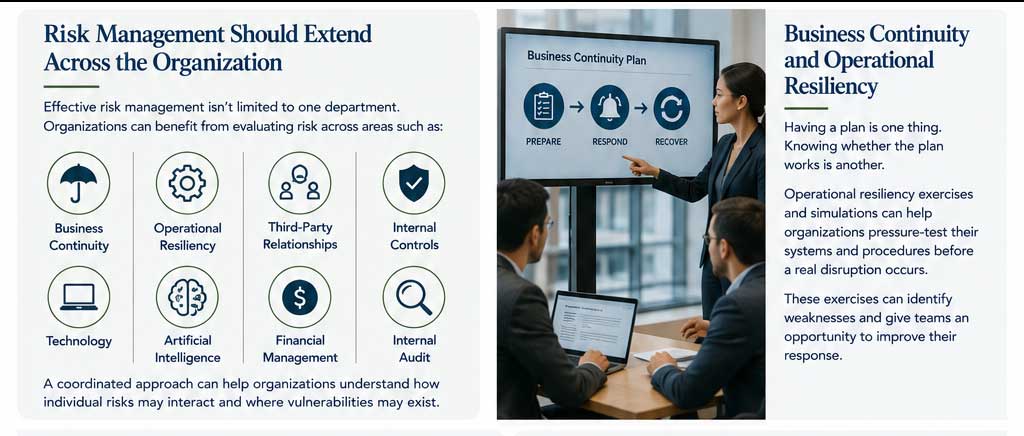
Risk Management Should Extend Across the Organization
Effective risk management isn’t limited to one department.
Organizations can benefit from evaluating risk across areas such as:
- Business continuity
- Operational resiliency
- Third-party relationships
- Internal controls
- Technology
- Artificial intelligence
- Financial management
- Internal audit
A coordinated approach can help organizations understand how individual risks may interact and where vulnerabilities may exist.
Business Continuity and Operational Resiliency
Having a plan is one thing. Knowing whether the plan works is another.
Operational resiliency exercises and simulations can help organizations pressure-test their systems and procedures before a real disruption occurs.
These exercises can identify weaknesses and give teams an opportunity to improve their response.
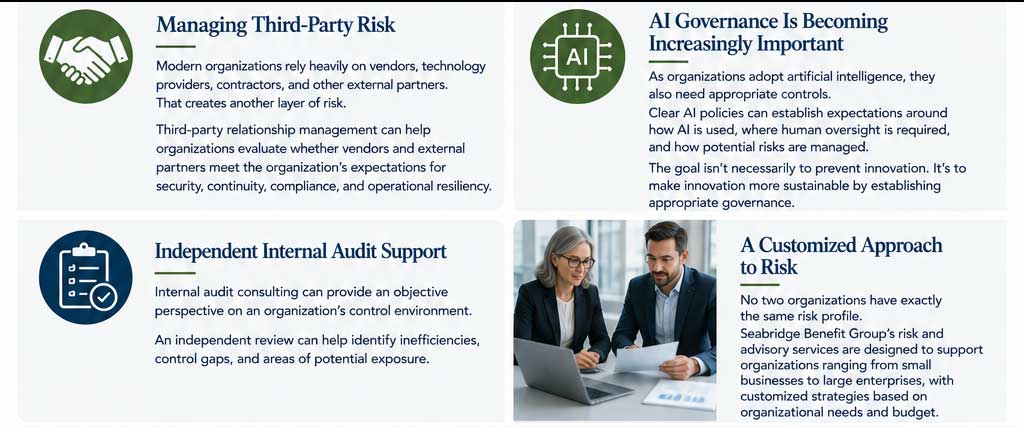
Managing Third-Party Risk
Modern organizations rely heavily on vendors, technology providers, contractors, and other external partners.
That creates another layer of risk.
Third-party relationship management can help organizations evaluate whether vendors and external partners meet the organization’s expectations for security, continuity, compliance, and operational resiliency.
AI Governance Is Becoming Increasingly Important
As organizations adopt artificial intelligence, they also need appropriate controls.
Clear AI policies can establish expectations around how AI is used, where human oversight is required, and how potential risks are managed.
The goal isn’t necessarily to prevent innovation. It’s to make innovation more sustainable by establishing appropriate governance.
Independent Internal Audit Support
Internal audit consulting can provide an objective perspective on an organization’s control environment.
An independent review can help identify inefficiencies, control gaps, and areas of potential exposure.
A Customized Approach to Risk
No two organizations have exactly the same risk profile.
Seabridge Benefit Group’s risk and advisory services are designed to support organizations ranging from small businesses to large enterprises, with customized strategies based on organizational needs and budget.
The post Enterprise Risk Management: Building a More Resilient Business appeared first on Seabridge Benefit Group.