

When life gives you lemons, invent a life-changing scientific instrument to measure the fruit’s acidity. At least, that’s what Dr. Arnold Beckman did 92 years ago when he created the world’s first pH meter.
While studying at the California Institute of Technology, Beckman was approached by a former classmate who needed a more reliable way to measure the acidity of lemon juice at a citrus processing plant. Beckman invented the acidimeter in 1934, a development that set the tone for his scientific career.
A year later, he founded National Technical Laboratories—later renamed Beckman Instruments Inc.—where he continued developing and manufacturing scientific instruments, including the spectrophotometer, which measures ultraviolet light.
Today, Beckman Coulter operates as two segments owned by Danaher Corporation, developing diagnostic systems used in hospitals and laboratories worldwide in Brea, while Beckman’s innovations in life sciences continue to influence fields ranging from medicine and biotechnology to aerospace and space exploration.
“There’s over a million tests an hour that are run on Beckman Coulter equipment,” current Diagnostics President Kevin O’Reilly told the Business Journal, noting that it impacts about 1.2 billion patients per year. “We impact human health globally.”
The Business Journal is marking the 250th anniversary of the United States by highlighting OC businesses that have made significant contributions to America and the world. Beckman can rightfully claim a major role in establishing Orange County as a hub of medical technology companies (Profiles start on page 20).
“Considered one of the top five inventors of scientific instruments, Dr. Beckman created devices that revolutionized the study and understanding of human biology, ultimately saving countless lives around the world,” according to the Beckman Coulter website.
Besides the acidimeter, later called the pH meter, he invented the DU Spectrophotometer in 1940 to simplify laboratory procedures, helped develop Southern California’s early smog regulations and, through his 1955 backing of Shockley Semiconductor Laboratory, played an early role in the rise of Silicon Valley (see page 55).
Though Beckman began in Pasadena, its growth exploded after moving its operations to Orange County in 1954, according to O’Reilly.
“I feel like the company started to blossom in the 50s,” O’Reilly told the Business Journal in an exclusive interview.
During that era, Beckman began shifting toward medical and life sciences devices, such as the Beckman Glucose Analyzer and the Beckman Protein Peptide Sequencer.
“By reducing the time to measure blood sugar levels from 30 minutes to three minutes, Beckman changed the game for diabetics,” according to “Orange County Inc.,” a 2016 book by Charles Martin on the history of Orange County’s most prominent businesses.
Beckman established a legacy in Orange County that thrives to this day, including a high school named after him in Irvine. The Arnold and Mabel Beckman Foundation, which is based in Irvine, has contributed $400 million to scientific research and education.
Becoming Beckman Coulter
Following its relocation to Fullerton, Beckman Instruments’ acquisition activity surged, driving significant growth that increased the company’s manufacturing capabilities and product portfolio and funded its overseas expansion.
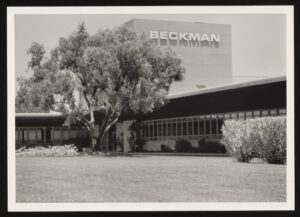
Company sales exceeded $100 million for the first time in 1965.
“The training videos were all based on the Fullerton campus,” said O’Reilly, who joined the company in 2023 and is a fan of Beckman’s history.
In another part of the country, Wallace Coulter had invented an instrument used to measure the amount of red and white blood cells in 1958 – creating the Coulter Principle, the basis of modern hematology.
He and his brother Joseph then founded Coulter Corp. in Chicago, producing and selling their patented product called the Coulter Counter.
Decades later in 1997, Beckman Instruments made its company-defining acquisition of Coulter Corp. for $875 million and emerged as the newly named Beckman Coulter. It became a $1.7 billion corporation that could provide 75% of the most used tests for clinical diagnostics, according to the company.
“You can’t talk about what we do in diagnostics without talking about the second part of the name — Coulter,” O’Reilly said.
Journey to Clinical Diagnostics
It was 1968 when Beckman started making instruments more applicable to diagnostics at hospitals and clinics, not just laboratories, according to its website. This was the first step towards merging with Coulter a few decades later for its blood cell analysis capabilities.
“Everything you do in science comes down to measurement. What we do today, which is diagnostics, we’re measuring proteins, antibodies, antigens or particles in blood,” O’Reilly said. “What (Beckman) did was build these measuring technologies.”
As part of its physical expansion, Beckman Instruments opened the Brea plant in 1979; the 34-acre site became the company’s home base in 2009 after consolidating its Orange County footprint.
With an estimated 400 employees in Orange County, Beckman Coulter Diagnostics ranks No. 2 on the Business Journal’s annual list of medical diagnostics and testing companies. Worldwide, the operating company counts nearly 10,000 employees in 35 facilities in more than 120 countries and territories.
In 2011, Washington D.C.-based Danaher acquired the firm for $6.8 billion, or $83.50 per share. Annual revenues had reached $3.7 billion and Beckman Coulter became a part of Danaher’s Life Sciences & Diagnostics segments.
“Beckman Coulter is an iconic company with a great brand, broad reach and technology leadership; well positioned in the markets it serves,” Danaher Chief Executive H. Lawrence Culp Jr. said in a statement at the time.
Beckman’s life sciences division moved to Indianapolis, where scientists study causes of disease and potential new therapies or drugs, and its medical diagnostics segment remained in Brea.
O’Reilly said the Beckman diagnostics arm designs and provides the testing equipment and platforms that doctors need to make a diagnosis, with laboratory professionals as its customers.
“You can’t get treatment without getting diagnosed,” said O’Reilly, who is also the group executive of Danaher’s diagnostics. “That’s ultimately what we do. We help doctors diagnose patients.”
Beckman Coulter’s current focus is on blood-based diagnostics for neurodegenerative diseases like Alzheimer’s, which is a recent development in neurology according to O’Reilly.
Its newest technology is the DXI 9000 analyzer, “a super high sensitivity analyzer that allows us to find things in blood that we weren’t able to find before,” O’Reilly described.
“We’re able to find the biomarkers — things that indicate the presence or absence of disease — now in the blood. In the same way that you go in for the blood draw for a basic comprehensive metabolic panel, we can now find the indicators that would tell you if you have a likelihood or a worry about having Alzheimer’s.”
Brea Campus Sold
This year, Dwight Manley purchased the medtech company’s historic Brea campus from Los Angeles-based Oaktree Capital Management LP for $140 million. Plans call to build a Costco at the site. Beckman Coulter’s lease expires in 2028, which will require the company to relocate its Brea-based teams.
“While we are not yet in a position to announce a new location, we are actively assessing options that will best support our associates and the continued growth of our business,” company spokesperson Jeff Tarmy said in a statement to the Business Journal. The diagnostics firm intends to stay in Orange County.
Beckman’s Role in Silicon Valley Formation
Arnold Beckman not only shaped Orange County as a hub for medical devices, he also played a key role in the formation of Silicon Valley, according to Kevin O’Reilly, Beckman Coulter Diagnostic’s current president.
In 1955, Beckman Instruments funded Shockley Semiconductor, which was founded by William Shockley, who had become famous as the co-inventor of the transistor that replaced bulky vacuum tubes and enabled modern electronics.
Shockley was Silicon Valley’s first semiconductor maker; within a few years, it eventually fell apart as its employees went on to start companies like Intel and Fairchild Semiconductor.
“It just broke off into a million little pieces and became Silicon Valley,” O’Reilly said.
Beckman helped “ignite” Silicon Valley, he said.
“He’s an Orange County success story, but he’s a real Californian success story.”
O’Reilly also highlighted Beckman’s role in World War II when his laboratory was asked to produce electronic radio-like components called helipots for then-secret RADAR systems in 1942. Beckman also became known for inventing a microammeter to assess plutonium for the Manhattan Project and an oxygen analyzer to improve the safety of submarines and high-altitude aircraft.
“This man was just an extraordinary inventor who was in so many different areas of science at the time,” O’Reilly said. “Ultimately, that pH meter was just one element.”
As his company continued growing, Beckman was known to walk the halls of the headquarters and be hands-on, according to company representatives. He died at the age of 104 in 2004.
Both Arnold Beckman and Walter Coulter have been inducted into the National Inventors Hall of Fame, in 1987 and 2004, respectively.
This year, another innovator from Orange County joined the ranks — Henry Samueli. He was inducted into the Inventors Hall of Fame in 2026 for his work at Broadcom.
—Emily Santiago-Molina
Beckman Coulter
FOUNDED: Arnold Beckman founded National Technical Laboratories in 1935; the company moved its operations to Fullerton in 1954.
LEGACY LEADERSHIP: Beckman revolutionized scientific measurement with the world’s first commercial pH meter and later developed the DU spectrophotometer, helping transform laboratory research and clinical diagnostics.
OC SIGNIFICANCE: Beckman’s move to OC helped establish the region as a center for medical technology. Today, Beckman Coulter’s diagnostic systems process more than 1 billion patient tests annually worldwide.
DEFINING MOMENT: Beckman Instruments acquired Coulter Corp. in 1997, creating Beckman Coulter, one of the world’s leading clinical diagnostics companies.
BY THE NUMBERS: Acquired by Danaher for $6.8B in 2011. Nearly 10K employees worldwide.